Modernizing legacy content and information management systems for scalability and performance.
Challenge
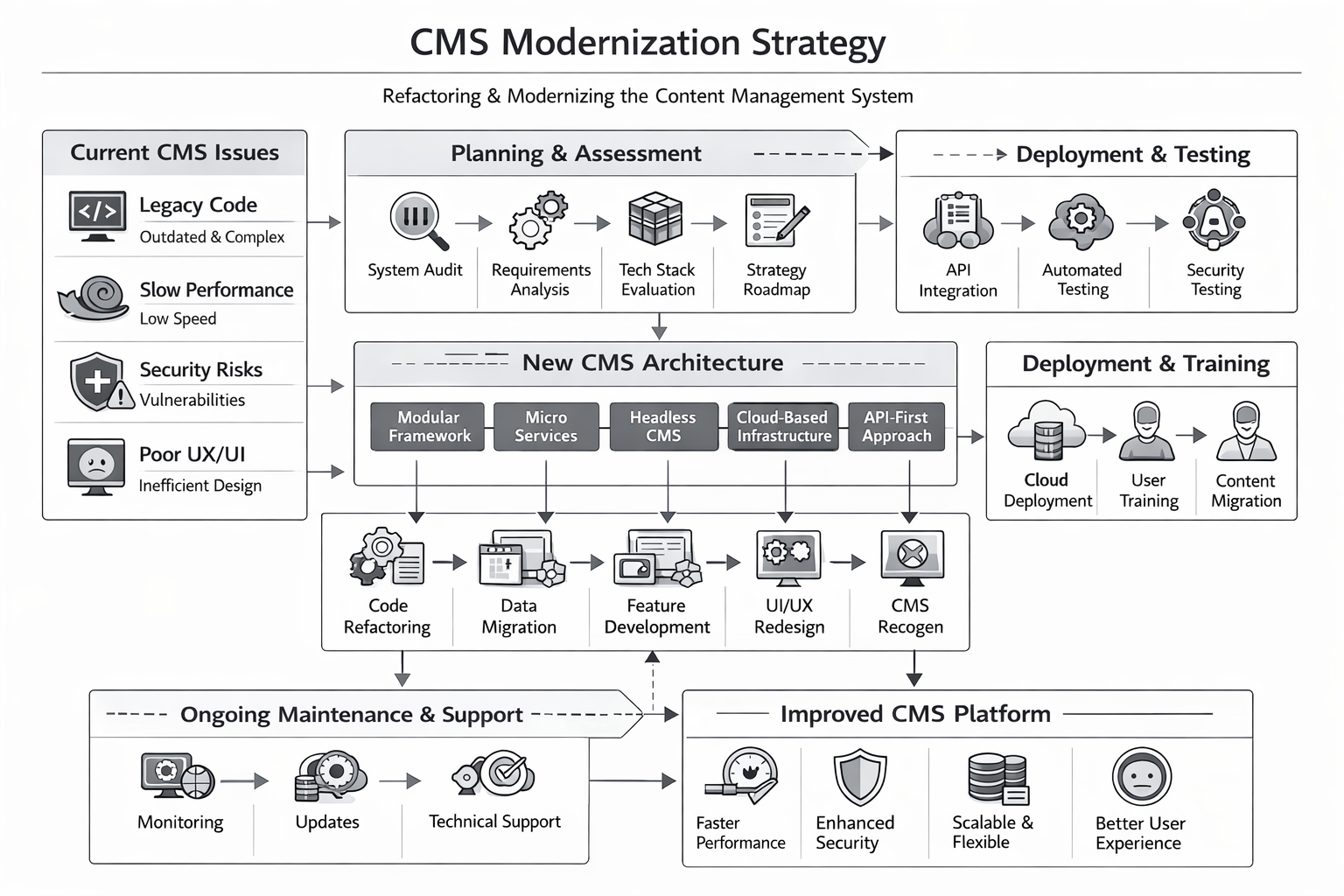
The organization was relying on outdated CMS and IMS platforms that had grown organically over time, leading to performance issues, difficult maintenance, and limited scalability.
Solutions
Refactoring and modularization of the existing systems into a scalable, maintainable architecture while preserving business-critical workflows
Technologies and tools
JavaScript, React, Node.js, PostgreSQL
Client
A large organization managing high volumes of structured and unstructured data across multiple departments. Their internal systems had evolved over time without a clear architecture, resulting in technical debt and operational inefficiencies. The need for modernization became critical as data volume and user demand increased.
Challenge: accumulated technical debt and system fragmentation
The legacy CMS/IMS ecosystem presented multiple issues:
Monolithic architecture that was difficult to scale or update.
Slow performance when handling large datasets.
Inconsistent data structures across modules.
High maintenance cost and dependency on legacy code.
Limited flexibility for introducing new features.
These limitations affected both internal teams and overall operational efficiency.
Solution: modular refactoring approach
We redesigned the system using a modular architecture that allowed gradual migration without disrupting existing operations.
Key improvements included:
Decoupling core functionalities into independent services
Standardizing data models and improving database structure
Optimizing performance for large data operations
Introducing API-first communication between modules
Enhancing UI for better usability and faster workflows
This approach ensured continuity while enabling long-term scalability.
Impact: improved performance and maintainability
The refactored system delivered immediate and long-term benefits:
Significant reduction in system response times
Lower maintenance overhead for development teams
Improved data consistency and reliability
Faster implementation of new features
Better user experience for internal stakeholders